Our Research in Detail
Explore our key technologies from atmospheric water harvesting to energy reconversion.
Vapor Compression Cycle Generation
Cooling ambient air below its dew point to produce clean water. Generators range from household (50 L/day) to industrial scale (1,000 - 7,000 L/day) powered by solar or wind energy.
- Operates at humidity levels as low as 30% (some models until 16%) with optimal production at 30°C and 80% RH (Hot coastal-zones)
- Specific Energy consumption (SEC) 0.25 and 1.5 kWh/L of water depending the conditions
- Process efficiency drops below 50% RH
- Solar/wind powered, easily installed
Research Focus
Thermodynamic Principle
A surface is cooled below the local dew point of moist air, forcing water vapor to condense into liquid droplets. The yield depends on absolute humidity, the temperature gap to dew point, and the heat-transfer area exposed to the airflow.
Vapor-Compression vs. Thermoelectric
Vapor-compression cycles use a refrigerant loop and scale well to hundreds of liters per day. Thermoelectric (Peltier) cooling is solid-state, silent, modular and ideal for compact, off-grid units powered directly by photovoltaic panels.
Energy & Efficiency
Specific energy consumption typically ranges from 0.25 to 1.5 kWh per liter of water. Our research targets reducing this through better heat exchanger design, hybrid cooling and smart control of the condensation cycle.
Climate Suitability
Condensation is most efficient above 50% relative humidity, with peak yield around 30 °C and 80% RH (hot coastal zones). Below ~30% RH the efficiency drops sharply which is where sorption-based AWH becomes the better approach.
Our Prototypes
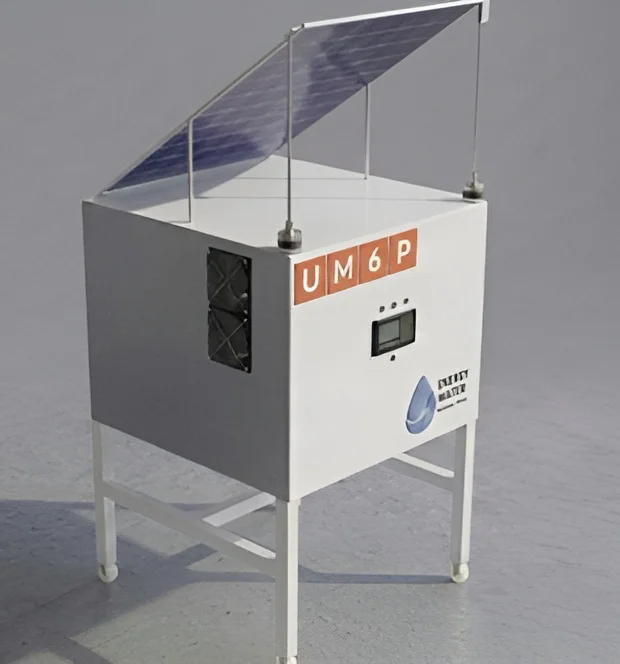
Multiphysics Modeling of Thermoelectric AWG
This research activity investigates the numerical modeling of thermoelectric atmospheric water generators through a simulation framework combining thermal, hydrodynamic, and mass transfer phenomena. The approach enables precise identification of key operating parameters cold-side temperature, airflow velocity, relative humidity range, and fin geometry without relying on trial-and-error methods. Building on these simulation outputs, a mobile and modular thermoelectric AWG prototype is being developed, mounted on a wheeled structure and equipped with a photovoltaic power supply for off-grid operation, with prototype testing currently underway at the E4W Center.
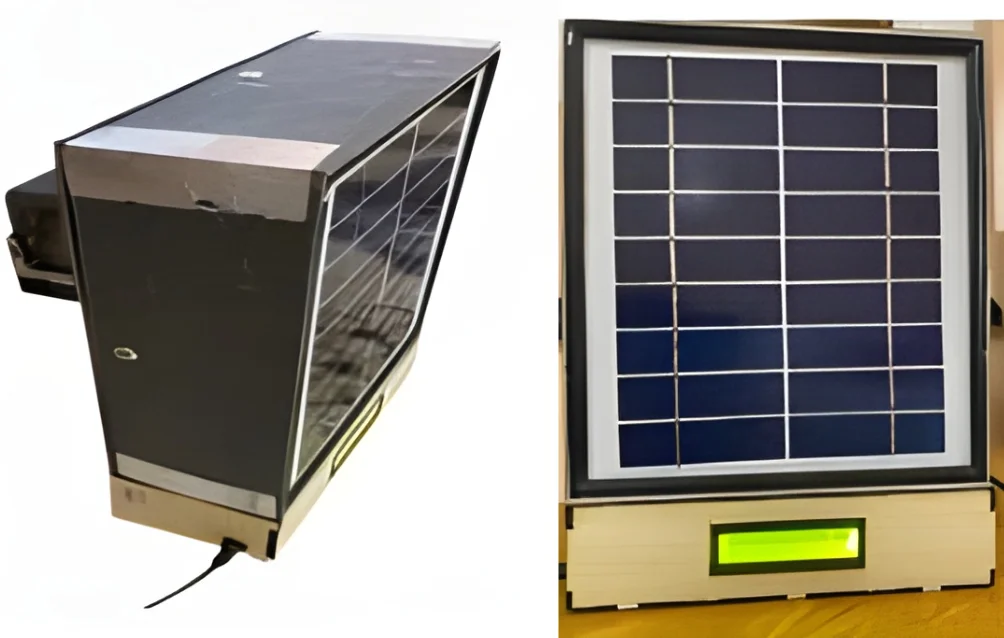
Peltier-based AWG with PV Integration
This prototype explores the development of a compact atmospheric water generator based on thermoelectric (Peltier) cooling, powered entirely by a photovoltaic panel. The system uses a thermoelectric module to cool a surface below the dew point and induce condensation, housed in a thermally insulated cold chamber with a dual-fan architecture managing heat dissipation on both sides of the module. An embedded control unit automates operation based on ambient temperature, making the system fully self-regulating and independent from the electrical grid. This development investigates whether a compressor-free, off-grid atmospheric water generator can produce water reliably under semi-arid conditions, and at what scale it becomes viable for decentralized and community applications.
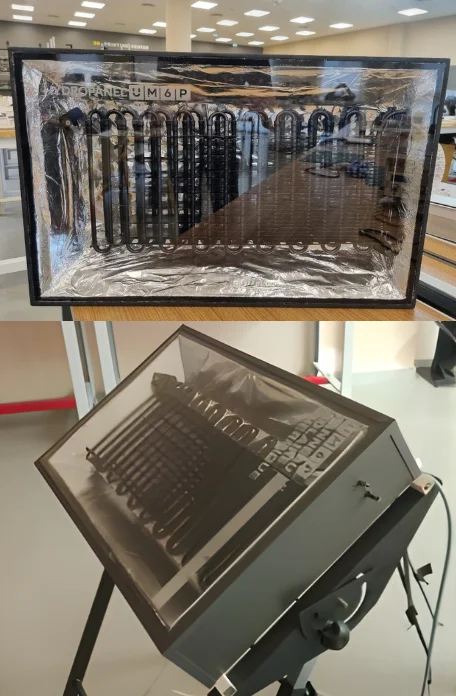
Solar-driven Passive Condensation Panel
This prototype investigates a fully passive atmospheric water harvesting panel driven solely by solar radiation, with no compressor, and no moving parts. Based on a simplified absorption principle, a working fluid circulates through the panel via a thermosiphon effect created by the solar thermal gradient between a cooler lower zone and a warmer upper zone, inducing condensation and collecting water without any mechanical input. This system is specifically designed to operate in arid and semi-arid conditions where conventional atmospheric water generation approaches underperform, offering a low-cost, low-complexity pathway to water production for remote and off-grid communities.
Sorption-based Atmospheric Water Harvesting (SAWH)
Water molecules of the atmosphere are trapped in a material and then desorbed by passive or active heating in a confined space and condensed at room temperature.
Research Focus
Adsorption / Desorption Cycle
During the night, water molecules from ambient air are captured inside the pores of a sorbent material (adsorption). During the day, gentle solar heating releases the trapped water as concentrated vapor, which is then condensed at room temperature.
Sorbent Classes
Two main mechanisms are studied: adsorption (Metal–Organic Frameworks, COFs, zeolites, silica gels) and absorption (hydrogels, hygroscopic salts, and salt–polymer composites). Each exhibits distinct performance in terms of water uptake capacity, sorption kinetics, and regeneration temperature requirements.
Why It Suits Arid Climates
Unlike condensation, sorption AWH stays effective in low-humidity environments down to 10-20% RH making it well suited to inland Morocco and other arid regions where conventional dew-point cooling is energetically impractical.
Energy & Materials Research
Our work focuses on synthesizing high-uptake, low-regeneration-temperature sorbents and integrating them into passive solar reactors, pushing toward higher daily yield per kilogram of material with minimal external energy input.
Our Prototypes
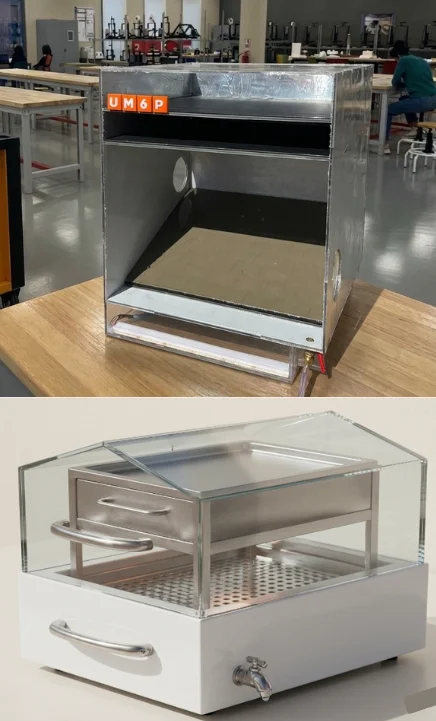
Sorbent Materials Development and System Design for Passive Atmospheric Water Harvesting
This research study investigates the development of sorption-based atmospheric water harvesting systems as a viable passive route to water production in dry and semi-arid climates. The work addresses a key challenge in the field where system integration rather than material performance alone limits overall output by developing a structured design framework that links performance targets to system architecture. The study explores architectural configurations, energy trade-offs, and control strategies to improve daily water yield under defined climatic conditions, with the objective of advancing sorption-based AWH toward reliable and reproducible prototype deployment.
Earth-to-Air Heat Exchangers (EAHX)
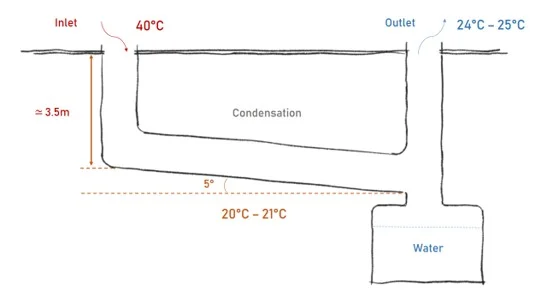
EAHX is a technique that produces water by condensing moisture from air underground. Air is first heated (e.g., using solar energy), then sent through buried pipes where cooler soil temperatures cause condensation. This method uses natural temperature differences and renewable energy to harvest water efficiently.
Potential for Hot Arid regions: Case of Benguerir
In regions like Benguerir, underground temperatures stay stable (around 20-21°C), while surface temperatures vary widely. This difference allows warm air to cool underground, creating condensation. As a result, water droplets form inside pipes, making the system effective for dry, hot climates.
Enhanced Efficiency:
The efficiency of EAHX systems increases by optimizing design parameters such as longer pipes, smaller diameters, and lower airflow, which improve heat exchange and condensation. Thin pipe materials and stable temperature distribution further enhance performance. This approach has been successfully applied in similar climates (e.g., in the USA), demonstrating its potential as a sustainable solution for water harvesting in arid regions.
Enhancing Resilience through Adaptive Soil Innovation
The AWH systems are primarily designed to supply drinking water to communities but can be scaled for agricultural use, including livestock. The team will utilize atmospherically harvested water to enhance agricultural production in several ways:
Sustainable Water Supply
By harvesting water from the atmosphere, these systems provide a reliable source of water, especially in arid regions where traditional water sources may be scarce, thus ensuring crops receive the necessary hydration for optimal growth.
Energy Efficiency
Sorption-based techniques used in these systems consume less energy, with a daily productivity of 1 to 3 L/m², making them a more sustainable option for water supply. This efficient use of energy allows for more resources to be allocated towards enhancing crop yield and soil health.
Modularity and Scalability
The systems can be adapted to meet varying agricultural needs, although this may come with higher capital costs and energy consumption. For instance, a system with a capacity of 7 m³/day requires approximately 50 kW of power, making it essential to evaluate the economic viability for high-value crops.
The Role of EAHX Systems
In addition to water generation, EAHX systems can help improve temperature control in agricultural facilities, offering alternatives to traditional greenhouses. Key features include:
Temperature Regulation
By utilizing fans for efficient heat exchange and leveraging underground pebbles as natural thermal batteries, these systems can store and release thermal energy, maintaining optimal growing conditions for crops and fertilizers.
Thermal Injections
Specific soils can be infused with thermal energy using passive systems, enhancing their ability to support plant growth while reducing reliance on energy-intensive heating methods.
Resilience Against Climate Variability
The interplay of soil, climate, and adaptability is crucial, as these systems are designed to enhance resilience against climate variability, ensuring sustainable agricultural practices.
The integration of atmospherically harvested water and innovative underground passive systems presents a promising pathway to improve agricultural productivity and sustainability, addressing both water scarcity and temperature control challenges in farming. By effectively utilizing harvested water, the E4W center aims to contribute to enhancing crop yield and overall agricultural resilience.
Redefining Resources: Atmospheric Water & Energy Reconversion
ENERGY > WATER > ENERGY
AWG technologies not only address water scarcity but open new avenues for energy reconversion. By providing a sustainable source of pure water, AWG directly supplies the feedstock for electrolysis, enabling large-scale green hydrogen production even in water-scarce regions (Cattani et al., 2023).
Atmospheric Water VS Green Hydrogen
By providing a sustainable and decentralized source of pure water, Atmospheric Water Generation (AWG) can directly supply the feedstock required for electrolysis, thereby enabling large-scale green hydrogen production even in water-scarce regions (Cattani et al., 2023) . Within UM6P’s multidisciplinary ecosystem, advancing AWG techniques offers a unique opportunity to simultaneously scale up water solutions for residential, agricultural, and industrial use, while also reinforcing Morocco’s strategic positioning in the global green hydrogen economy.
Atmospheric Water VS Sustainable Fuels
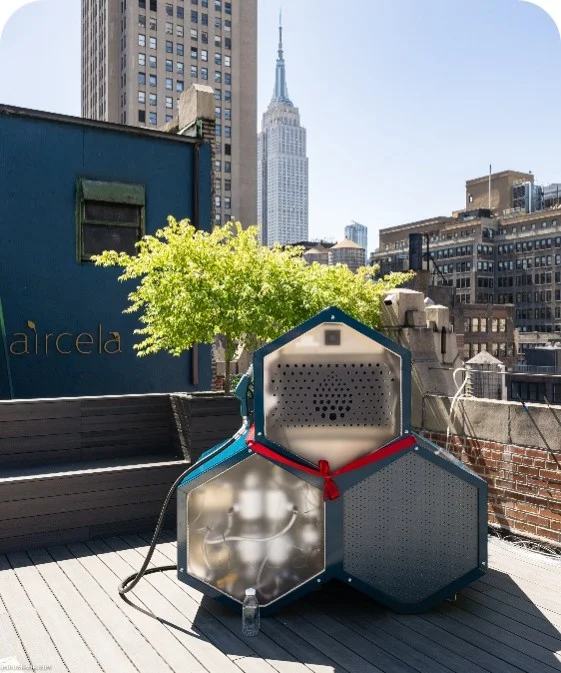
Aircela has created a compact system that turns air, water, and renewable electricity into fossil-free gasoline, offering a decentralized solution for clean fuel production.
- Captures CO₂ directly from air using a KOH-based sorbent.
- Uses renewable-powered electrolysis to split water, generating hydrogen.
- Combines CO₂ and hydrogen into methanol, then converts it into gasoline via MTG catalysis.
- Produces engine-ready fuel on-site, suitable for off-grid or distributed use.
Source: aircela.com